Monday, May 18, 2026

Week 37 2026 Portfolio & State Test

May 18-22, 2026 


Submit Portfolio (100pts)
https://goo.gl/forms/ler1PEhnRR6D9Qgn2

State Test Code (50pts)

Period 8NQI3J6NPY

 https://signin.youscience.com/

Practice Test:
Digital Media Practice Test

Assignment: Study for test.

2019 Digital Media 1B State Standards

STANDARD 8
2D Animation -- Students will produce and utilize 2D animation.

:-) (-:

Keyframe
Frame by Frame Animation:
Tween
FPS: Frames Per Second
24 FPS for Animation.

STANDARD 9
Digital Video: Students will plan, create, edit, and publish digital video.

Camera Angles

Helpful websites for study:
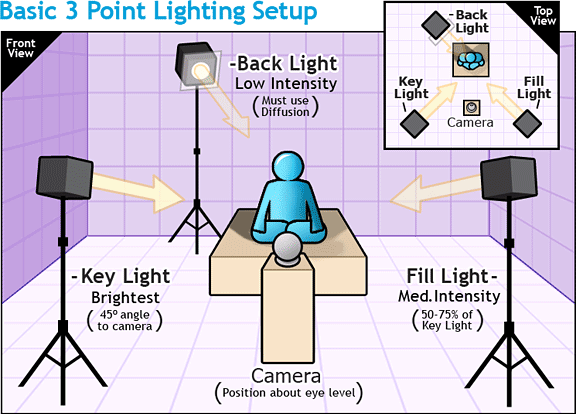
  3 Point Lighting Diagram
http://www.mediacollege.com/lighting/three-point/ Lighting
http://www.mediacollege.com/lighting/ambient/ Ambient Lighting

Point Light:
http://escience.anu.edu.au/lecture/cg/IlluminationJ3D/pointLights.en.html


Aspect Ratio: 
http://apex.infogridpacific.com/dcp/flo-aspect-ratio.html


Thursday, May 14, 2026

Week 36 2026 Special Effects

May11 -15, 2026 

Objective: Create animation effects.
Assignment: Special Effects
Description: Download 5 images. Organize them into a folder. Open After Effects and apply effects to your images.
Recommended Sizes: 1980 x1080 72dpi

Download 5 Images: https://www.pexels.com/

Examples: 


Monday, May 4, 2026

Week 35b 2025 Production Intro

May 4 - 8, 2026

Objective: Edit multiple layers of video
Assignment: Create a Production Company Intro using Photoshop & After Effects
Details: Layout a background, Name, and Graphic in Photoshop. Import Photoshop file into After Effects to animate for 5 to 10 seconds. Export to movie.
Link: https://freemangraphics.weebly.com/film--video.html


Video Tutorials


Week 35 2026 Camera Tech

May 4 - 8, 2026 


Objective: Explore Camera Techniques.
Assignment: Camera Tech
Details: Click on the link and copy and paste the worksheet: Camera Tech


Production

-Script
-Storyboard
-Shot List
-Filming


Post Production

-Capture Footage
-Editing
-Exporting Assignment: Shot List
Details:
Links: http://www.thewildclassroom.com/wildfilmschool/gettingstarted/camerashots.html
DISCUSSION: Log on to your Canvas account to complete your assignment.

Camera Shots, Angles, and Movements

I’m sure you’re itching to start shooting.  In fact, I bet you already have, but do you know the tricks of the trade?  Do you know the industry standards?  Before you start making a new style for yourself, you better know what tools you have to choose from.

Rule of ThirdsProper framing

The first thing to learn is how to frame your subject.  If you’re a still photographer you’ll already know about the rule of thirds.  This works for filmmaking as well.  Notice the website below. 
The rule of thirds:
This is a general principle in photography, which is generally considered to make shots more appealing to the eye.  One can easily visualize this rule by taking a frame and dividing the horizontal piece into three equal sections and dividing the vertical in three equal sections.  This creates 9 equal sections.  Where these sections meet are four points on the frame.  By aligning the central object into these points of the frame (often called the power points), instead of centering the object, you get more aesthetically and professional-looking shots.
However, we should note that while we describe this as the RULE of thirds, it might better be used as a guideline. 
Common uses of this rule in video are:
  • Framing an interview: The eyes of your subject should fall in one of the upper powerpoints and the subject should be looking towards the empty space on the frame.
  • Shooting a horizon: Rather than position the horizon on the center of the frame, align it along the upper or lower third depending on what you want to emphasize.  For example, if you’re shooting a cloud time-lapse you will want two-thirds of the shot centered on the sky.

Basic Camera Shot types:

Extreme Wide Shots (EWS) act to establish the area.
Wide Shots (WS) show the entire person or area.  They’re great for establishing the scene and allow for good action of the characters.  Sometimes this is known as the long shot.
Medium Shots (MS) frame the subject from the waste up.  This is the most common shot and allows for hand gestures and motion.
Medium Close Ups (MCU) shots show the subject in more detail and are often framed from just below the shoulders to the top of the head.
Close Ups (CU) show a particular part of your subject.  For people this usually means the shot frames just the head!
Extreme Close Ups (ECU) are much tighter close-up shots in which you get detail greater than the human eye might be able to normally perceive.  An example of this shot might be of the mouth and eyes together
Camera Shots and Angles

Advanced Camera Shot Types

Two Shot: This is a shot of two peoples (or other individuals) together. 
Cut Away (CA): Cutaways are used in the editing process to fill in footage which is different from the main action.  B-roll is often used for cut-aways.  An example might be a cut away of a bird singing if the shot is focused on a couple in the woods. 
Over the Shoulder Shots (OSS) are shot from behind the person towards their subject.  Generally the frame is cut off just behind the ear, although there are several variations.  A good technique to use to get this shot is to frame the person facing the subject with about one third of the frame.
Point of View (POV): This is an effective shot that gives the audience the feel that you’re seeing it from the eyes of the performer.  It is taken from near the eye-level of the actor and shows what he might see.  It could be used to give the perspective of other animals too like a frog, a bird, or a fish.
Selective Focus: By using a large aperture value (f/1.4, f/2.0) you will be able to create a shallow depth of field.  This effectively leaves one part of the frame in focus while blurring others, such as the foreground or background.  When you change the focus in the shot from the foreground to the background you’re doing another advanced camera shot called a rack focus.

Tuesday, April 28, 2026

Week 34b 2026 Group Video

April 27 - May 1, 2026 

Group Film Projects
Assignment: Script, Storyboard, Shot list
Description: Choose a prop. Write a script, create a storyboard and shot list. Film your video. Use five different camera angles.

Pre Production (Week 1 April 27 - May 1)

-Script
-Storyboard
-Shot list

Production (Week 2 May 1 - 8)

-Filming

Post Production (Week 3 May 11 - 15)

-Capturing Footage
-Editing
-Exporting

Film Project (300pts)
-50pts (Script, Storyboard, Shot List)
-50pts (Group Intro)
-50pts ( Title, Credits)
-50pts (5 Camera Angles)
-50pts (2 Sound FX)
-50pts (Export video clip)

Editing Skills

Details: Edit video clips
-Create a project folder
-Slice Video Clips
-Add Titles
-Add Effects: (examples: lighting effects, slow motion, reverse clip etc..)
-Add Transitions
-Remove and Add Sound
-Export or render clips into a stand alone movie.

Example: 


Week 34 2026 Video Editing

April 27 - May 1, 2026 


Objective: Edit Video Clips
Assignment: Re Edit Movie Trailer -100 pts
Description: Download and re-edit a movie trailer in iMovie. Find a movie on YouTube then download using a you tube downloader.


YouTube Down loaders

https://www.dlnowsoft.com/youtube-mp3
http://www.bestvideodownloader.com/
https://youtubemp4.biz/
Firefox: Easy Youtube Video Downloader Express
http://www.clipconverter.cc/


Free Videos:
https://www.videvo.net/
 https://www.pexels.com/

Links for Sound:
Sound Bible: http://soundbible.com/
FMA: http://freemusicarchive.org/genre/Electronic/
Imcompetech: http://incompetech.com/
Find Sounds: http://www.findsounds.com/

Details:
Show the following skills in your re-edit of a movie trailer:
-Slice Video Clips
-Add Titles
-Add Effects: (examples: lighting effects, slow motion, reverse clip etc..)
-Add Transitions
-Remove and Add Sound
-Export or render clips into a stand alone movie.


Monday, April 20, 2026

Week 33 2026 Final Cartoon

April 20- 24, 2026 

Assignment: Final Cartoon Animation
-5 Sound FX (50pts.)
-Title & Credits (50pts.)
-Final Animation (50pts.)


Cartoon Project
Points
March 16-20Week 29
Character Design & Storyboard
100
March 24-27Week 305 Backgrounds50
March 30-Apr 3Week 31
Sound FX & Animation
150
April 13-17Week 32Title & Credits50
April 20-24Week 33
Testing & Submit Portfolio
350


Photoshop Assignments